
Last updated:
Start with the decision a serious truck crash creates
Choosing legal help after a serious Texas truck crash starts with more than finding the closest office. You need to decide whether the lawyer can evaluate the available crash record, identify the questions that still need answers, explain the possible next steps, and tell you whether the matter fits the lawyer’s practice. A nearby location may make communication easier, but proximity alone does not establish suitability, representation, or a likely result.
The practical answer is to use a record-first screening process. Begin with what happened and what you can preserve. Then compare the lawyer’s relevant personal-injury and civil-trial qualifications, ask how the consultation works, and keep the boundaries of general information in view.
The decision path can stay focused:
- Describe the crash without guessing. Separate what you saw, what you were told, and what remains unknown.
- Preserve available information. Keep photographs, witness details, medical records, bills, messages, emails, and notes together.
- Screen for relevant experience. Look for a stated focus on serious truck accidents and qualifications connected to personal-injury and civil trial work.
- Prepare focused questions. Ask what the lawyer needs, what the review can address, and what it cannot determine before a full evaluation.
- Choose the next step based on fit. A prepared consultation can help you decide whether to continue with that legal practice, without assuming that every matter will be accepted.
Your situation may involve your own injuries, support for an injured family member, or the consequences of a death. The same screening method applies, but the facts will control what can be evaluated. This guide does not assign responsibility, calculate damages, determine a filing deadline, or predict whether representation will be offered.
Why a heavy-truck crash may require focused evaluation
A heavy-truck crash deserves a focused evaluation because the useful questions extend beyond the moment of impact. You may need to organize information about the vehicle, the driver, the scene, witnesses, property damage, medical records, communications, and the roles of the people or organizations identified in those records. Do not assume that the vehicle in the crash tells you everything that must be examined.
NHTSA’s cited material classifies heavy trucks as vehicles with a gross vehicle weight rating greater than 26,000 pounds, corresponding to Classes 7 and 8. That classification gives you a useful way to describe the type of vehicle involved, but it does not decide responsibility or tell you whether your matter qualifies for representation.
The available crash record should help frame questions such as:
- Who was driving, and what does the report or other record identify about the vehicle?
- Which people or organizations appear in the available paperwork, communications, or insurance information?
- What evidence describes the road, traffic controls, weather, vehicle damage, and position of the vehicles?
- Which witnesses can describe what happened, and how can their contact information be preserved?
- Which injuries, treatment records, bills, or functional changes need to be gathered for review?
These questions are screening tools, not conclusions about who is legally responsible. The available information may not show which roles exist in your crash, and a consultation cannot turn an unanswered question into an established fact.
A truck-accident lawyer should be prepared to discuss the records that make your situation different from an ordinary vehicle-damage question. The Law Offices of John David Hart represents clients in truck-accident cases, including automobile and truck accidents, catastrophic personal-injury, wrongful-death, and workplace-injury matters. That stated scope gives you a concrete subject to ask about; it does not promise that every truck case will be accepted or produce a particular result.
Preserve the information that may explain what happened
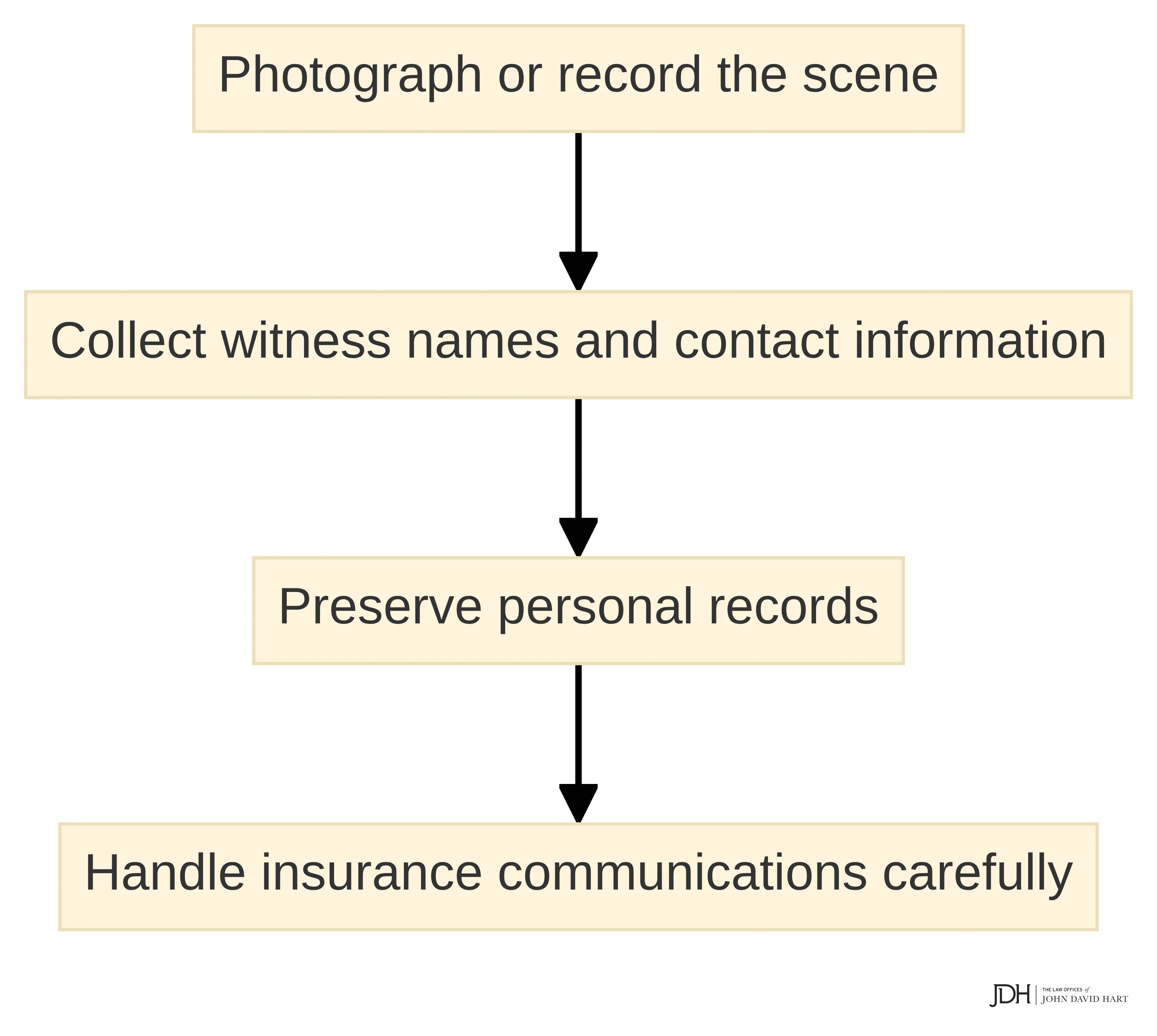
Crash-scene preservation starts with making a usable record of conditions that may later be difficult to revisit. Photograph or record the crash scene, vehicle damage, road conditions, traffic signs, weather, and visible injuries when doing so does not create another hazard. If you can do so without creating another hazard, keep the files in their original form and add a simple note describing when and where each image was made.
Do not edit an image in a way that removes context. Do not place yourself or anyone else in danger to obtain a photograph. The purpose of this step is to preserve available information, not to recreate the crash or prove a legal conclusion by yourself.
Witness information can become difficult to reconstruct later. Record each witness’s name and available contact information, along with what the person says they saw, as close to the person’s exact words as possible.
A simple witness note can include:
- the person’s name and available phone number or email address;
- where the person was located in relation to the crash;
- what the person said they observed; and
- the date you made the note.
Keep your own observations separate from a witness’s account. That separation makes it easier to explain which details come from your memory and which came from someone else.
Your personal records should remain together in a form you can use during a consultation. Preserve medical records, bills, photographs, text messages, emails, and handwritten notes about the crash and injuries. Add the police report if you have obtained it, along with vehicle, insurance, towing, and repair documents that are already available to you.
Preservation does not require you to understand the legal significance of every page. Keep the original message or document when possible, label copies clearly, and write down what is missing rather than filling gaps with guesses.
Insurance communications require care. Whether to sign documents or give a recorded statement to an insurance company without legal advice requires individualized review. If an insurer sends you a document or asks for a recorded statement, treat the request as a question to raise promptly with qualified counsel rather than assuming that this general article answers it.
Organize promptly without treating urgency as a deadline ruling
Prompt organization gives you a clearer starting point when crash information is spread across photographs, witness details, records, bills, messages, emails, and notes. Evidence-preservation guidance recommends keeping those categories of information, so begin with what is already available rather than waiting for a perfect file.
Prompt organization is not a ruling about a legal deadline. It does not establish that you qualify for representation, determine who is responsible, or show what a claim may be worth.
A working timeline can make your first conversation more precise. Use short entries for the crash, emergency or other documented care, communications with insurers, vehicle storage or repair information, and important changes you noticed afterward. Mark each entry as one of three things:
- Known: supported by your own record or a document you have.
- Reported: told to you by another person or shown in a record you have not yet evaluated fully.
- Unknown: a question that still needs an answer.
This method helps you avoid presenting an assumption as a fact. It also gives you a clean list of questions to bring to a consultation.
Urgency should change how you organize, not make you guess. Do not invent a vehicle role, injury detail, witness statement, or insurance fact to make the timeline look complete. Do not treat a general article as a limitations determination. If a deadline, notice requirement, evidence issue, or communication concern may affect your situation, place it on the consultation question list for a fact-specific review.
Build a focused consultation packet from available records
A consultation packet should help you explain the crash, show what records exist, and identify what remains unresolved. The packet does not need to contain every document before you seek help. A clear index and an honest list of missing information are more useful than a disorganized collection that hides the main questions.
The first packet group should describe the event:
- the approximate date, time, and location as you understand them;
- the vehicles and people identified in the records you have;
- photographs or recordings of the scene, damage, road conditions, traffic signs, weather, and visible injuries;
- witness names and contact information; and
- the police or incident report if you have it.
This group includes photographs or recordings, witness information, and the circumstances recorded about the crash. Label each item with a short description instead of writing a legal theory into the file.
The second packet group should contain the records connected to injuries and financial effects that are already available. Include medical records, bills, photographs, text messages, emails, and handwritten notes about the crash and injuries. Keep copies of correspondence from insurers and other parties, but do not assume that an insurer’s description of the event is the final account.
Preserving these records may help explain the sequence and effects of the crash. The records do not, by themselves, establish responsibility, damages, or eligibility for representation.
The third packet group should contain your questions and unknowns. Write down what you want the lawyer to address, such as whether more records should be preserved, which people or organizations need to be identified, what the stated practice scope covers, how the review is handled, and what information is still needed. Add a one-page timeline if it helps you explain the sequence without turning uncertain details into fixed statements.
Your packet has one immediate use: it gives you a structured way to communicate during the consultation. Send or bring only what the lawyer requests through the available intake process, protect private information, and keep your own copy. A packet cannot replace individualized legal analysis, and a missing document should remain marked as missing rather than reconstructed from memory.
Evaluate relevant truck-accident and trial qualifications
The Law Offices of John David Hart includes truck-accident matters in its stated practice scope. For a Texas crash involving serious injury or death, compare the facts you can provide with that stated scope. It does not mean that every matter fits or that representation will follow a consultation.
John David Hart is board certified in both Personal Injury Trial Law and Civil Trial Law by the Texas Board of Legal Certification. Those are specific qualifications you can place beside the questions raised by your crash. They do not supply the missing facts of your case, determine responsibility, or predict an outcome.
Use the same questions for any lawyer you are considering:
- Does the stated practice include serious truck-accident matters?
- Can the lawyer explain how the available records would be reviewed?
- Are the lawyer’s personal-injury and civil-trial qualifications clear?
- Can you identify what the consultation can address and what requires further review?
- Are the communication and fee arrangements explained in ordinary language?
A lawyer who answers those questions directly gives you more useful information than a lawyer selected only because the office is nearby.
Understand what a free case review can and cannot establish
A free case review is an opportunity to present the available facts and ask whether the matter appears to fit the practice’s stated scope. It can help you organize the central questions, identify records that may need attention, and understand what further information a lawyer needs before discussing options. It is not a decision on liability, damages, a filing deadline, representation, or recovery.
The Law Offices of John David Hart offers free, confidential consultations for catastrophic-injury cases. If your serious truck crash involves that type of injury, the offer gives you a defined starting point for discussing the available record. The consultation offer does not establish that your matter will be accepted or that a particular legal result will follow.
The Law Offices of John David Hart states, “We charge no fee unless the case is won.” That is the firm’s stated fee condition. A fee condition does not answer every question about a potential engagement, so use the consultation to understand the terms that would apply if representation is offered.
The limits of a review matter as much as its possible value. A review cannot fill in facts that you do not have, guarantee that the practice will represent you, decide whether another person or organization is legally responsible, calculate a case value, or promise recovery. Your role is to provide an accurate account and ask direct questions; the lawyer’s role is to evaluate the specific matter under the facts and law that apply.
Ask questions that clarify whether the matter fits
Consultation questions should test both the crash record and the working fit with the legal practice. Write your questions before the conversation so stress or missing information does not cause you to skip the issues that matter most.
Consider asking:
- What information would you need first to evaluate this truck crash?
- Which parts of my record are clear, and which questions remain open?
- Which people or organizations identified in my records should be examined further?
- What documents, photographs, witness details, or communications should I preserve now?
- How does your stated truck-accident and personal-injury focus relate to the facts I have described?
- What do your Personal Injury Trial Law and Civil Trial Law qualifications mean for the type of review I am seeking?
- What can this consultation clarify, and what will require additional investigation or legal analysis?
- If representation is offered, what fee and case-cost terms would apply?
- What information should I provide if I do not yet have a report, witness contact, or insurance document?
- What should I avoid assuming about responsibility, deadlines, or recovery while the facts are being reviewed?
The answers can help define the next decision. Use the answers to distinguish facts the lawyer has reviewed from facts that still need support, and to assess whether the practice’s stated scope addresses the kind of truck crash and injury you described.
The comparison is easier if you record each answer under the same four headings: (1) records the lawyer reviewed; (2) facts or documents still missing; (3) questions the lawyer says require additional investigation or legal analysis; and (4) terms or limits explained for any potential engagement. This prevents you from treating a general statement about truck-accident experience as an evaluation of your particular crash.
Also note whether the lawyer responds to uncertainty directly. A useful response can distinguish your account from a witness account, identify which records support a point, and say when the available information is not enough to reach a conclusion. You do not need to resolve those gaps during the first conversation. Mark them as open items and ask what information would help address them.
If you speak with more than one lawyer, use the same packet and questions for each conversation. Compare the clarity and relevance of the explanations, not promises about responsibility, case value, representation, or recovery. The resulting notes can support a careful next-step decision: continue a conversation, gather a requested record, or seek clarification about the practice’s scope and terms. None of those choices determines the legal merits of the matter.
Keep comparison notes separate from the underlying records, and label your own impressions as questions rather than facts. That preserves the distinction between what was said during intake and what a later legal evaluation may establish.
Your notes from the conversation should preserve the questions asked, documents discussed, and items that remain unresolved. Evidence-preservation guidance recommends keeping records such as medical documents, bills, photographs, text messages, emails, and handwritten notes about the crash and injuries. Add the consultation notes to that organized file, while keeping the notes factual and separate from conclusions you have not yet established.
Take the next step with a prepared request for review
Your next step is to gather the records you already have, mark the facts that remain uncertain, and compare your questions with The Law Offices of John David Hart’s stated truck-accident scope and John David Hart’s board certifications in Personal Injury Trial Law and Civil Trial Law. A qualified Texas attorney must assess your specific facts and applicable law; general information cannot establish responsibility, eligibility, a deadline, a case value, representation, or recovery.
Questions to ask before requesting a truck-accident case review
What should I do immediately after a truck accident?
After a truck accident, it’s important to preserve evidence. Photograph the crash scene, vehicle damage, and any visible injuries. Request a police report and keep all medical records and communications related to the crash.
What types of cases does The Law Offices of John David Hart handle?
The Law Offices of John David Hart represents clients in cases involving truck accidents, catastrophic personal injury, wrongful death, medical negligence, and workplace injuries.
What can I expect during a free case review?
During a free case review, you can present the facts of your case and ask whether it fits the firm’s practice scope. The review helps identify records that may need attention and clarifies what further information is required.
What qualifications should I look for in a truck accident lawyer?
When evaluating a truck accident lawyer, look for a stated focus on serious truck cases, personal injury experience, civil trial qualifications, and clear communication about what the consultation can address.
What should I prepare before contacting a truck accident lawyer?
Before contacting a lawyer, gather all relevant records, including photographs, witness information, medical records, and any communications with insurance companies. Prepare a list of questions to discuss during the consultation.
Hurt in a trucking & 18-wheeler accidents situation?
Talk directly with John David Hart — board-certified Texas trial lawyer. Free, confidential, no fee unless we win.
Get a Free Case Review Call 817-870-2102