
Last updated:
Start with the decision a case review is meant to support
A case review is a structured conversation about what happened, how the accident affected you, what information exists, and whether further legal guidance makes sense. It is not a ruling that you have a valid claim, a prediction of compensation, or a commitment to pursue a lawsuit.
If you are deciding whether to contact an accident attorney, start with a narrower question: would a case-specific review help you understand the issues that general information cannot resolve? That question is especially useful after a serious injury, a death in your family, a disputed account of the accident, an insurance problem, or losses that may continue beyond the first medical bills.
You do not need a finished legal theory before asking for guidance. You need a clear account of the accident and the records you already have. A case review can then focus on the difference between what is known, what remains uncertain, and what should be addressed next.
Use this guide as a preparation tool rather than as a substitute for an assessment of your circumstances. The practical path is:
- Screen the situation for facts that make individualized guidance worth considering.
- Keep general Texas information separate from conclusions about your accident.
- Organize available records in five categories.
- Record disagreements instead of trying to resolve them yourself.
- Bring the organized information to a case review without assuming that the review determines representation or an outcome.
The goal is a better decision about the next conversation, not an answer that the available facts cannot support.
Screen the situation without treating a guide as a legal conclusion
A serious accident can create several separate questions at once: what caused it, how severe the injury is, who may have relevant information, how insurance is responding, and whether losses are continuing. You do not need to answer those questions before requesting guidance. You can use them to decide whether a case review would be useful.
Consider requesting individualized guidance when one or more of these circumstances applies:
- Your injury required emergency care, hospitalization, surgery, rehabilitation, or continuing treatment.
- Your symptoms affect work, mobility, daily activities, communication, memory, or your ability to care for your family.
- The accident caused a death, or your family is handling losses connected with a fatal event.
- The facts are disputed, the available accounts differ, or another person or business is assigning responsibility to you.
- An insurer has asked for a statement, questioned the loss, delayed communication, or made an offer before you understand the full effect of the injury.
- You have substantial medical expenses, missed work, damaged property, or other documented losses that are difficult to organize.
- You are unsure which records matter, which insurer was involved, or whether an earlier communication could affect your next decision.
These circumstances do not establish liability, eligibility, or a right to compensation. They identify situations in which a general article is less likely to answer the question you actually face.
The absence of an ambulance ride, hospital admission, disputed liability, or immediate financial loss does not answer the legal question either. An accident can remain factually unclear even when the first response seemed straightforward, and symptoms or financial effects can change as information develops. Do not manufacture seriousness, certainty, or blame to justify asking for help.
A useful screen is to write down three sentences:
- What happened, in the order you remember it.
- What injury, loss, or unresolved question concerns you most.
- What decision you need help making now.
If you can state those points honestly, you have enough to begin organizing a request. The review will be more useful if you label assumptions as assumptions and separate what you saw from what someone else told you.
Separate general Texas information from a case-specific assessment
General Texas information can describe legal categories and identify questions to ask, but it cannot apply every fact to your accident. Texas limitations rules vary by claim. Section 16.051 is identified for claims without another expressly applicable limitations period; that general rule is not an answer to a deadline for a specific accident.
That distinction matters because the same event can raise different issues depending on the parties, the injury, the type of claim, the available insurance, and the facts surrounding the loss. A general explanation may help you recognize a question without resolving it. Treat any time-sensitive rule as a reason to seek case-specific guidance rather than as permission to wait.
Keep these two columns separate while preparing:
| General information can help you understand | A case-specific review must assess |
|---|---|
| The kinds of records that may explain an accident or injury | Which facts and records matter in your circumstances |
| The difference between insurance coverage and a legal claim | How the available policies and communications apply to the loss |
| Why conflicting accounts should be preserved rather than guessed away | Which account, if any, can be supported by the available information |
| Why timing should be checked rather than assumed | Which deadline or procedural requirement may apply to your situation |
| The questions you want answered | Whether the known facts support a particular legal path |
This table is a planning aid, not a test for whether you have a claim. Use it to avoid turning a broad rule into a personal conclusion.
You can make the distinction clearer by changing the wording of your notes. Instead of writing, “The other driver is liable,” write, “The other driver turned left, and the crash report says the impact occurred in the intersection.” Instead of writing, “My case is worth a certain amount,” write, “These medical bills and work records show losses I need to discuss.”
Specific observations preserve accuracy. Conclusions can wait for a review of the full circumstances.
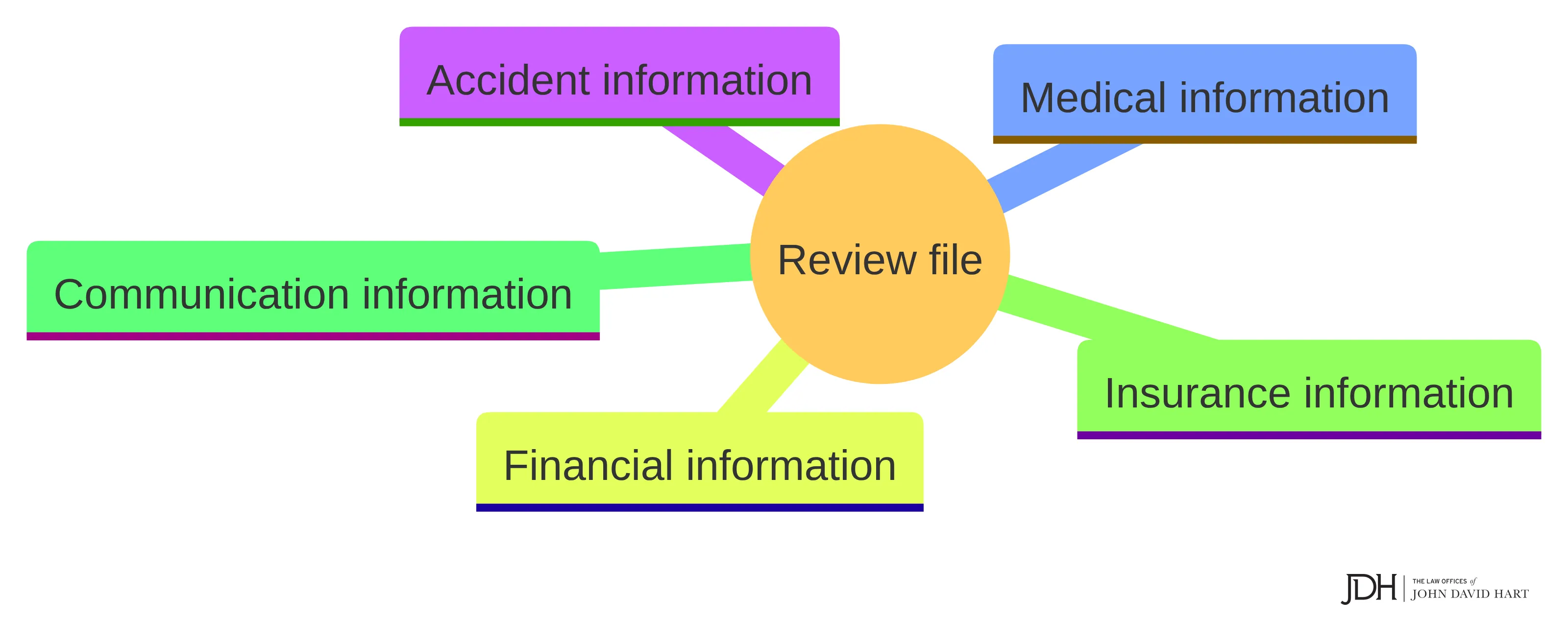
Build the review around five kinds of information
Five categories give you a practical way to prepare without trying to calculate a claim or prove every issue in advance:
- Accident information: the date, approximate time, location, vehicles or equipment involved, people present, emergency response, photographs, videos, reports, and your account of what happened.
- Medical information: the body parts or conditions affected, providers visited, treatment received, restrictions, follow-up appointments, and records that describe how the injury affects daily life.
- Financial information: medical charges, paid expenses, insurance payments or denials, missed work, reduced work capacity, property damage, and other documented costs connected with the accident.
- Insurance information: policy names, claim numbers, adjuster contact information, coverage correspondence, statements requested or given, offers, denials, and records showing which insurer covered you at the time.
- Communication information: messages, emails, letters, recorded-call notices, conversations you documented afterward, and communications with insurers, employers, medical providers, witnesses, or other involved parties.
The categories overlap. A medical record may explain a work restriction, and an insurance letter may refer to a medical bill. Keep the original items together when possible, then use a short index to show where each item belongs.
The point of this five-part file is not completeness. It is usability. A reviewer should be able to see what happened, what changed, what has been paid or requested, which accounts conflict, and what question you want answered.
Use a simple folder structure:
- 01 Accident
- 02 Medical
- 03 Financial
- 04 Insurance
- 05 Communications
Add a one-page timeline at the front. Mark missing items plainly instead of filling gaps from memory. If you have only photographs and a few messages, bring those. Available information is more useful than delaying a conversation while you try to create a perfect packet.
After the folders are assembled, create a one-page review index rather than sending a reviewer a stack of unconnected files. For each important item, record:
- The question or fact it relates to.
- The category where the original item is stored.
- The document, person, or communication that supports it.
- Whether it is confirmed, reported by someone else, disputed, or missing.
- The question you want the review to address.
Use those labels to describe the state of your information, not to decide credibility or legal responsibility. A document may confirm that a communication occurred without proving the accuracy of everything stated in it. Similarly, a missing record is a gap to identify, not evidence that a particular fact did or did not occur.
The index can also show relationships among categories. A medical restriction may connect to a missed-work entry; an insurance letter may refer to a bill; and a communication may identify a report or photograph that is not yet in the file. Note those connections without treating them as proof of causation, coverage, or responsibility. This helps the review address the question behind each document rather than merely confirming that the document exists.
Prioritize items that could change the next conversation. Put disputed accounts, continuing treatment, insurer requests or denials, uncertain policy information, and response dates near the top. That does not mean those items establish a claim or deserve a particular outcome. It means they are less useful when buried in a general folder. If an item is incomplete, write what is missing and who may have it, if known. If you do not know who has it, say that instead of guessing.
Before submitting a request, read the index as a short handoff: what happened, what changed, what records support the account, what remains contested or unavailable, and what you want clarified. Keep the underlying originals even if the index is the first thing you share. This structure makes an incomplete file easier to discuss while preserving the boundary between organizing information and reaching a legal conclusion.
Record what happened and where accounts differ
Your accident record should preserve the event as you remember it and identify the records that may confirm, contradict, or add context to that account. Begin with a neutral timeline rather than an argument about fault.
Include:
- Where you started and where you were going, if that context matters.
- The roadway, worksite, premises, or other location.
- Weather, lighting, traffic, equipment, signals, or visible conditions you remember.
- The sequence immediately before the impact or injury.
- The impact, fall, exposure, or other event itself.
- What you did afterward, including emergency calls, medical care, photographs, and notifications.
- Names and contact information for witnesses, drivers, employers, property owners, or other involved parties when available.
Use approximate language when that is what you know. “Around 6 p.m.” is more reliable than an exact time you invented later. Do not edit a photograph, message, or contemporaneous note to make it fit a conclusion.
Conflicting accounts deserve their own section. Create a short list with three columns: the issue, your account, and the record or person offering a different account. The issue might be the traffic signal, the direction of travel, the condition of a work area, the timing of a report, or whether a symptom existed before the accident.
This list does not decide which account is correct. It tells you where a review needs to slow down. Preserve the original report, photograph, message, or recording information rather than relying only on a summary you wrote later.
Do not contact a witness to coach an account or ask another person to change a statement. Record what you know, preserve what you have, and identify the disagreement for discussion.
If the accident occurred in an oilfield, industrial, construction, or other work setting, add the worksite details you can identify: employer or contractor names, job assignment, equipment involved, training or instruction records in your possession, incident reports, and the names of people who were present. That list does not determine responsibility. It helps keep the review connected to the setting in which the injury occurred.
Add medical information that explains the injury’s impact
Medical information should show more than the name of an injury. It should help explain when symptoms began, what treatment occurred, what providers observed, and how the condition affects your ordinary activities. Gather the records and bills you already have, along with appointment dates, prescriptions, therapy information, restrictions, referrals, and follow-up instructions.
The Texas Department of Insurance advises asking your doctor to provide your insurer or HMO with details about your treatment, medical condition, and prognosis. That advice concerns information for the insurer or HMO; it does not determine the legal significance of your medical history or predict your recovery.
Keep a symptom and treatment log if it helps you describe changes accurately. Note the date, symptom, activity affected, appointment, medication issue, or restriction. Do not use the log to replace medical advice, alter a medical record, or assign a diagnosis.
Organize medical information by provider and date:
- Emergency or urgent-care records.
- Hospital, surgical, imaging, and specialist records.
- Primary-care and follow-up visits.
- Physical, occupational, or other therapy records.
- Prescription and medical-device information.
- Bills, payment records, and insurance explanations of benefits.
- Work, school, or activity restrictions.
- Names of providers whose records are still pending.
Include information about earlier conditions when it is relevant to your symptoms or treatment. Hiding a prior condition can create confusion; describing it accurately gives a case review a better factual starting point. The purpose is not to argue that every symptom came from the accident. The purpose is to show what changed, what was treated, and what remains uncertain.
Medical records and legal conclusions answer different questions. A diagnosis can describe a condition without deciding who caused it or what legal issues apply. A treatment bill can document an expense without establishing who must pay it. Bring both the records and your questions, and let the review distinguish medical description from legal assessment.
Document financial losses without estimating claim value
Financial information should show what you paid, what you were billed, what income or work activity changed, and which amounts remain uncertain. Do not turn the file into an estimate of what the case is worth. A case review needs organized facts before it needs a number.
Create separate lists for:
- Medical bills and out-of-pocket treatment expenses.
- Insurance payments, adjustments, denials, and balances.
- Prescription, transportation, equipment, or home-assistance expenses connected with treatment.
- Time missed from work and the records that show the absence.
- Changes in duties, hours, pay, or work capacity after the accident.
- Vehicle, equipment, clothing, or other property damage.
- Household costs or services that changed because of the injury.
Attach the document that supports each entry when you have it. Label an amount as pending, disputed, estimated, or paid instead of presenting every figure as final.
A short financial timeline can make the effect of the accident easier to understand. Record the date of the accident, the first expense, each major treatment event, missed work periods, insurance communications, and payments or denials. Add a note when a cost is unrelated, partly related, or still being investigated.
This approach protects against two common errors. You do not lose a small but recurring expense because it seemed unimportant at first, and you do not present an uncertain total as a settled fact. Keep receipts, pay records, invoices, benefit statements, employer communications, and repair estimates in their original form when possible.
Pain, reduced independence, disruption to family routines, and changes in daily activity may be difficult to express in a spreadsheet. Describe the practical effect with dates and examples: what you could do before the accident, what changed afterward, what treatment or assistance followed, and whether the change continues. That description is evidence of your experience, not a promise of a particular legal result.
Review insurance information and communications carefully
Insurance information belongs in its own section because coverage and legal responsibility are different questions. Texas consumer guidance states that required minimum liability coverage is $30,000 per injured person, $60,000 per accident, and $25,000 for property damage, commonly called 30/60/25 coverage. Those figures describe the cited minimum liability coverage; they do not determine the limits, exclusions, or available coverage in your particular policies.
Collect the declarations pages, policy numbers, claim numbers, adjuster information, letters, emails, recorded-call notices, estimates, payment explanations, and denial reasons you possess. Note whether a communication concerns vehicle damage, bodily injury, medical payments, liability, or another coverage category. Do not assume that a letter about one category answers a question about another.
If you changed insurers after an accident, the insurer covering you when the accident occurred generally remains involved in that claim, while the new insurer does not cover the earlier accident under the cited Texas guidance. Preserve information from both insurers and identify the policy that was in effect on the accident date. A later policy change does not by itself answer every coverage question.
Insurance communications can contain requests for medical details, statements, authorizations, bills, or other information. The Texas Department of Insurance advises asking your doctor to provide the insurer or HMO with treatment, medical-condition, and prognosis details. Keep a record of what was requested, when it was requested, what you sent, and how the insurer responded.
Read before responding. Save the original message and your response. If you do not understand a request, list it among the questions for a case review rather than guessing about its legal effect.
Do not delete messages, ignore a denial, or rely on a phone conversation that you did not document. A simple communication log can include the date, sender or recipient, subject, action requested, response provided, and document attached. It will not resolve a coverage dispute, but it will show the sequence that a review needs to examine.
Treat timing as a reason to verify, not a deadline answer
Timing deserves attention because the date of an accident, the date an injury was discovered, later communications, and other facts may affect which rules need review. It does not provide a specific deadline for your accident.
Do not use a general limitations statement to decide that you have plenty of time or that your opportunity has already ended. Write down the accident date, treatment dates, discovery of significant symptoms, insurance notices, and any date mentioned in a legal or insurance communication. Then ask for a case-specific assessment of which dates matter.
Organize promptly for accuracy, not because this guide can announce a deadline. Early notes can preserve details that become harder to recall, and a dated file can show how treatment, work, communications, and losses developed. Prompt organization also helps you identify missing records while the names, locations, and sequence remain familiar.
If a letter or form gives you a response date, place it at the top of your communication log. Do not ignore it, and do not assume that sending a quick response resolves the underlying issue. Include the document in the information you bring for review.
A deadline question is not the same as a claim conclusion. The date information may show why you need individualized guidance, but it does not establish liability, damages, or the proper legal strategy. Keep those questions separate.
Know what a review can and cannot establish
A case review can help you put the accident, injury, losses, insurance information, and disagreements into a usable sequence. It can identify missing information, explain which questions need closer examination, and help you consider whether further legal discussion may be appropriate based on the facts you provide.
A case review cannot make incomplete information complete. Treat a submitted request or conversation as a request for assessment, not as an assumption that representation will follow.
Prepare questions that test the boundaries of the review:
- What facts need clarification before the next decision?
- Which records should I try to obtain or preserve?
- Which parts of my account are disputed or uncertain?
- What insurance information should be examined separately?
- What timing issue requires verification for my circumstances?
- What would the next stage involve if further guidance is appropriate?
- What does this conversation not establish?
These questions keep the conversation practical. They also make it easier to distinguish an explanation of possible issues from a conclusion about your individual situation.
You can leave a review with a clearer list of next questions even if no immediate decision follows. That is a useful result when the available facts are incomplete. Do not treat uncertainty as a negative answer or confidence as proof; record both as part of the decision process.
Evaluate whether the available firm information fits your situation
At The Law Offices of John David Hart, we represent clients in catastrophic personal injury, wrongful death, medical negligence, automobile and truck accident, and workplace injury cases. That stated scope includes several situations covered by this guide, but it does not mean that every accident matter fits or that representation is appropriate without a case review.
Compare your situation with the stated categories without forcing it into one. Identify whether the event involved an automobile, truck, workplace, catastrophic injury, medical negligence, or a death. Then describe the facts rather than adopting a label. The review can address whether the available information fits the work described.
At The Law Offices of John David Hart, we offer free, confidential consultations for catastrophic injury cases, and we charge no fee unless the case is won. Those are the consultation and fee terms we offer. They do not promise acceptance, representation, a particular fee calculation, or a result in your matter.
Bring the same organized information whether your question concerns a serious car crash, truck accident, workplace event, or another injury-related loss. This information gives you a basis for deciding whether to request a conversation; it does not replace that conversation.
Use fit questions instead of reputation questions:
- Does the stated case scope overlap with the accident and injury you need to discuss?
- Can you explain the central facts and the main unresolved question?
- Do you have the available records organized by accident, medical, financial, insurance, and communication information?
- Are you prepared to identify what is known, what is disputed, and what remains missing?
- Do the consultation and fee information fit the kind of conversation you are seeking?
A “yes” to these preparation questions does not predict the outcome. It means you can make a more informed request for review.
Request a free case review with the information available
Your next step can be simple: write the three-sentence account, gather the records you already have, and identify the question you need answered. Put accident, medical, financial, insurance, and communication information into separate groups, mark disputed facts, and include any document that raises a timing or response concern.
Do not wait for a perfect file, and do not assume that submitting information decides whether you have a claim. A qualified legal professional must assess individual suitability and the facts of your situation. The purpose of the request is to begin that assessment with an accurate, organized account.
If you are in or connected to Fort Worth, Texas, and are evaluating legal guidance after a serious accident or injury-related loss, The Law Offices of John David Hart offers free, confidential consultations for catastrophic injury cases and charges no fee unless the case is won. Bring the information available, describe what remains uncertain, and let the consultation address whether the matter fits the available scope.
What should I expect when I request an accident case review?
What should I consider before contacting an accident attorney in Texas?
Consider reaching out for legal guidance if your injury required emergency care, if there are disputed facts about the accident, or if you have significant medical expenses or ongoing treatment needs. These circumstances may indicate that a case-specific review could be beneficial.
What types of information should I gather for a case review with an accident attorney?
Prepare to provide organized information in five categories: accident details, medical records, financial losses, insurance information, and communication records. This will help the attorney assess your situation more effectively.
How does liability coverage work in Texas for accidents?
In Texas, liability coverage is required by law, with minimum coverage of $30,000 for each injured person, $60,000 per accident, and $25,000 for property damage. This coverage pays for the other party’s medical costs and damages if you are at fault.
What is the purpose of a case review with an accident attorney?
A case review helps clarify the details of your accident, injury, and losses, and identifies any missing information. It does not guarantee representation or predict the outcome of your case.
Are consultations with The Law Offices of John David Hart free?
Yes, The Law Offices of John David Hart offers free, confidential consultations for catastrophic injury cases and charges no fee unless the case is won.
What should I do if I have conflicting accounts of the accident?
Document the conflicting accounts and preserve all original records. This information will be important for discussion during your case review.
Hurt in a trucking & 18-wheeler accidents situation?
Talk directly with John David Hart — board-certified Texas trial lawyer. Free, confidential, no fee unless we win.
Get a Free Case Review Call 817-870-2102