
Last updated:
Build a written comparison before requesting a case review
A Fort Worth search can give you names, locations, and descriptions, but it does not establish which details fit your family’s matter. Use those results only to begin a written comparison. For each lawyer you consider, note the current qualifications and practice details you can verify directly, record when you checked them, and mark anything still unclear for follow-up.
A useful comparison asks whether the lawyer’s experience and working approach match the matter you need to discuss. Your situation may involve a vehicle crash, an industrial incident, a medical error, an oil-and-gas event, or another death that requires careful examination of different records and possible causes. The relevant question is not which name appears highest in a search result. The relevant question is whether the lawyer can explain how the facts would be examined and what remains unknown.
Place each lawyer side by side and label each entry as confirmed, unanswered, or unclear. Keep the detail supporting each label beside it, and write down the next check for every unanswered or unclear item. If a detail is not confirmed, leave the entry open rather than treating a general description as an answer. The completed comparison helps you decide whether to request a case review; it does not rank lawyers or forecast a claim’s result.
A case review is a decision point, not a promise that a claim can be filed or won. Bring the facts you have, ask direct questions, and listen for a clear explanation of both possibilities and limits. If the conversation does not address your family’s circumstances, you have a reason to keep evaluating fit rather than relying on a broad marketing statement.
Use the Texas legal category only as an initial screen
A Texas wrongful-death claim is a civil action arising from a death caused by another person’s wrongful act, neglect, or default, allowing certain beneficiaries to seek damages for losses caused by the death. A Texas wrongful-death claim requires proof of fault, causation, and damages tied to the death, not merely to the injury that preceded it. That legal category gives you a starting point for evaluating whether a lawyer understands the kind of inquiry your family may need.
The Texas legal category is an initial screen rather than an answer about your family’s eligibility. The death may have followed a crash, workplace event, medical treatment, or another incident, and the relevant facts will differ from one matter to another. Ask how the lawyer would examine the alleged wrongful act, the connection between that act and the death, and the losses your family says resulted from it. A lawyer should be able to separate those questions instead of treating the existence of a death as proof of fault.
An initial legal conversation can test whether the lawyer is addressing the right questions:
- What facts would help establish what happened?
- What competing explanations would need to be examined?
- What information would connect the conduct being questioned to the death?
- Which family losses would need documentation?
- What can be assessed now, and what would require further investigation?
The answers should remain tied to the facts you provide. General information cannot decide whether those elements can be established in your matter.
A focused case review should leave you with a clearer list of factual questions, not a premature conclusion. If a lawyer moves directly from a general description of your incident to a confident assessment of eligibility or value, ask what facts support that assessment and what facts still need to be tested.
Check whether the lawyer understands the family’s potential claim structure
The difference between a wrongful-death claim and a survival action is one useful test of legal understanding. Use that distinction as one topic to raise during a case review.
A focused review should identify which losses are being discussed and whose losses they represent. You may need to describe the family’s loss of support, companionship, or services separately from medical expenses, pain, lost wages, or other losses associated with the deceased person before death. The two claim structures can arise from one incident, but that does not make them interchangeable. Ask the lawyer to explain the distinction in terms that match your family’s circumstances.
Questions about claim structure can include:
- Which family members’ losses would the lawyer examine?
- What information would show the deceased person’s condition between the injury and death?
- Which records relate to the family’s losses, and which relate to the deceased person’s losses?
- Could more than one claim structure arise from the same incident?
- What facts would change the lawyer’s preliminary view?
You do not need to label the claim before the conversation. Give the lawyer a complete account of the incident and the period that followed.
A lawyer who explains the distinction clearly is giving you a more useful basis for comparison than a lawyer who uses one broad label for every loss. The explanation still remains provisional until the relevant facts, records, and current Texas law are applied to your matter.
Verify who must be included in the conversation
Texas law significantly limits who may file a wrongful-death lawsuit: a surviving spouse, child, or parent may file, either together or with one person filing for the benefit of all of them. That description identifies a starting group for the lawyer’s review, but a surviving-spouse, child, or parent relationship does not by itself resolve your family’s legal position.
A family map helps you present the relationships clearly. Write down the deceased person’s surviving spouse, children, and parents, including family members who live outside Fort Worth or outside Texas. Note who has been communicating with other relatives, who has relevant records, and whether the family has different views about pursuing a claim. Do not treat the list as a final legal determination; use it to make sure the lawyer hears about the people who may matter.
A useful claimant question set includes:
- Who needs to participate in the initial conversation?
- Can one surviving family member speak for the group at the beginning?
- How should the family handle different views about the matter?
- What information does the lawyer need about the family relationships?
- What questions remain unanswered about who may bring or benefit from a claim?
Give the lawyer the family structure before asking for a firm conclusion. The conversation should account for the people connected to the potential claim rather than relying on a single relative’s account.
A family member can request an initial discussion, but that step does not decide who may sue or how any claim must be organized. Include the relevant relatives and identify disagreements early so the lawyer can address them under the facts and current Texas law.
Compare relevant experience and service information
A relevant experience screen looks beyond a general personal-injury label. Ask whether the lawyer handles wrongful-death matters and related catastrophic-injury cases, and whether the lawyer has worked with facts resembling yours. A crash, industrial incident, medical-negligence matter, and oil-and-gas event may require different records, witnesses, and questions. You are comparing relevance, not collecting a title.
Investigation questions can show whether the lawyer has a concrete plan for developing the facts. Ask how the lawyer would approach the incident record, identify people or organizations whose conduct may need examination, preserve information, and evaluate conflicting accounts. You can also ask what outside professionals or technical explanations might be needed, without assuming that any particular expert will be used. The answer should distinguish what the lawyer can assess from what would require additional investigation.
A trial-capability comparison should focus on how the lawyer handles uncertainty and contested facts. Ask how the lawyer prepares when responsibility is disputed, how the family would be informed about major decisions, and what would happen if the matter does not resolve early. Do not treat a promise of a particular result as evidence of capability. A careful explanation of possible paths is more useful than an assurance that no adverse issue will arise.
Service information matters because wrongful-death matters often require sustained communication with more than one family member. Ask who would be your primary contact, who would perform the day-to-day work, how updates would be delivered, and how quickly the office generally responds to questions. Ask whether the lawyer personally evaluates the matter and who would attend important meetings or proceedings. Record the answers so you can compare actual working arrangements rather than general statements about personal attention.
Representation terms should be part of the comparison from the beginning. Ask about the fee arrangement, case expenses, responsibilities for costs, what happens if the representation ends, and which terms would be set out in a written agreement. Ask how the lawyer explains expenses that may arise during investigation or litigation. A free initial conversation and a representation agreement are different steps; do not assume that the terms of one answer every question about the other.
A concise experience-and-service checklist can include:
- Similar wrongful-death or catastrophic-injury matters handled.
- Experience with the type of incident involved in your family’s matter.
- The proposed investigation and evidence-preservation approach.
- The lawyer and staff members who would handle the work.
- Communication frequency, contact methods, and decision-making expectations.
- Fees, expenses, written terms, and unresolved questions about representation.
Use the checklist to compare explanations. Do not convert a credential, case description, or marketing phrase into a prediction about your outcome.
Test the comparison with questions before choosing representation
An initial case review should give you enough information to decide whether the lawyer’s approach fits the matter, not pressure you into an immediate conclusion. Prepare questions in advance and leave room for the lawyer to ask questions about the incident, the deceased person, the family, and the records. A useful conversation identifies both the next factual step and the limits of what can be said at that point.
Incident questions can help you compare how each lawyer approaches the underlying facts:
- What facts about the crash, workplace event, treatment, or other incident need closer examination?
- Which people, businesses, or agencies may have information about what happened?
- What explanations for the death should be considered rather than assumed away?
- What information should the family preserve now?
- What would make the lawyer change the initial assessment?
Describe what you know and mark what you do not know. A lawyer should be able to distinguish an established detail from an assumption or family recollection that still needs support.
Evidence questions can focus the discussion on what is available and what is missing. Ask which records would help test fault and causation, whether any records may be difficult to obtain, and whether the lawyer sees a need for witnesses or technical review. Ask how the lawyer would handle conflicting documents or accounts. These questions do not require you to know the legal answer; they show whether the lawyer has a method for finding it.
Claim-structure questions should address both the family’s losses and the deceased person’s losses before death. Ask whether the lawyer is evaluating a wrongful-death claim, a survival action, or both, and what information supports that preliminary view. Ask which relatives need to be included in the conversation and whether any family disagreement could affect the next step. Request an explanation tied to your facts rather than a generic description of Texas law.
Staffing and communication questions should be concrete:
- Who will be the family’s primary contact?
- Who will investigate the incident and review records?
- How will the office communicate significant developments?
- Who will make decisions about settlement discussions or litigation strategy?
- How should you report new information or urgent concerns?
Write down the answers and note any answer that remains unclear. Your comparison should reflect the working relationship you are being offered, not only the name on the website.
Representation-term questions should cover fees and costs without assuming that one arrangement applies to every matter. Ask what would be free, what would require a written agreement, how expenses would be handled, and what happens if the lawyer does not take the case. Ask about the timing of any decision and what information the lawyer needs before discussing representation. Use the answers to identify terms that require further explanation before you decide.
A clear answer can include uncertainty. Ask, “What can you tell me now, and what cannot be determined until more facts are reviewed?” A lawyer who identifies the missing information gives you a better basis for deciding whether to continue the conversation. Take the next step only after you understand what the lawyer is assessing and what remains open.
Build a Texas wrongful-death review packet from what the family has
A Texas wrongful-death review packet should organize what your family already has without requiring you to collect every record first. Use one folder for documents, one page for the family timeline, and one list of questions. Label each item with its date and source when you can. Keep original records safe and provide copies or electronic versions for discussion.
Incident information should explain what happened, when it happened, where it happened, and who may have seen or documented it. Include the names of employers, drivers, medical providers, contractors, businesses, or agencies connected to the event when you know them. Add photographs, videos, messages, insurance communications, and your own timeline. Mark disagreements between accounts instead of trying to resolve them yourself.
Medical information can help show the period between the incident and death. Gather available treatment records, bills, discharge information, and communications with providers. Include the death certificate when you have it, and note the dates and locations of treatment. Do not delay the conversation while waiting for a complete medical file; tell the lawyer which records have been requested or are still unavailable.
Family and financial information can help the lawyer understand the losses you want to discuss. Prepare a list of surviving relatives and the deceased person’s relationship to the household. Gather available employment records, pay information, benefit information, household-service details, and documents showing recurring financial responsibilities. Keep estimates separate from records, and label an estimate as an estimate.
For an initial case review, potentially useful materials include police or accident reports, medical records, a death certificate, witness statements, scene photographs or videos, employment records, and expert opinions. You may not have every item. Bring what you have and identify the gaps so the lawyer can explain what may be needed next.
A review packet works best when it separates three things: what your family knows, what a document shows, and what still needs investigation. Add a short chronology and a page of questions at the front. Give the lawyer the names of people who may have information, but do not pressure witnesses to change or rehearse their accounts. Preserve the information as it exists and let the lawyer explain the next appropriate step.
A family can request a review with an incomplete packet. Gather the available incident, medical, family, and financial information, note what is missing, and bring the unanswered questions with you.
Treat timing as a verification issue, not a self-applied deadline
Texas timing can depend on the type of action, the people involved, the defendant, and the facts of the matter. A general date found in an online guide should not become your self-applied deadline. Give the date of death, the incident date, the treatment dates, and any notice or communication dates to a Texas lawyer promptly so the relevant timing questions can be identified.
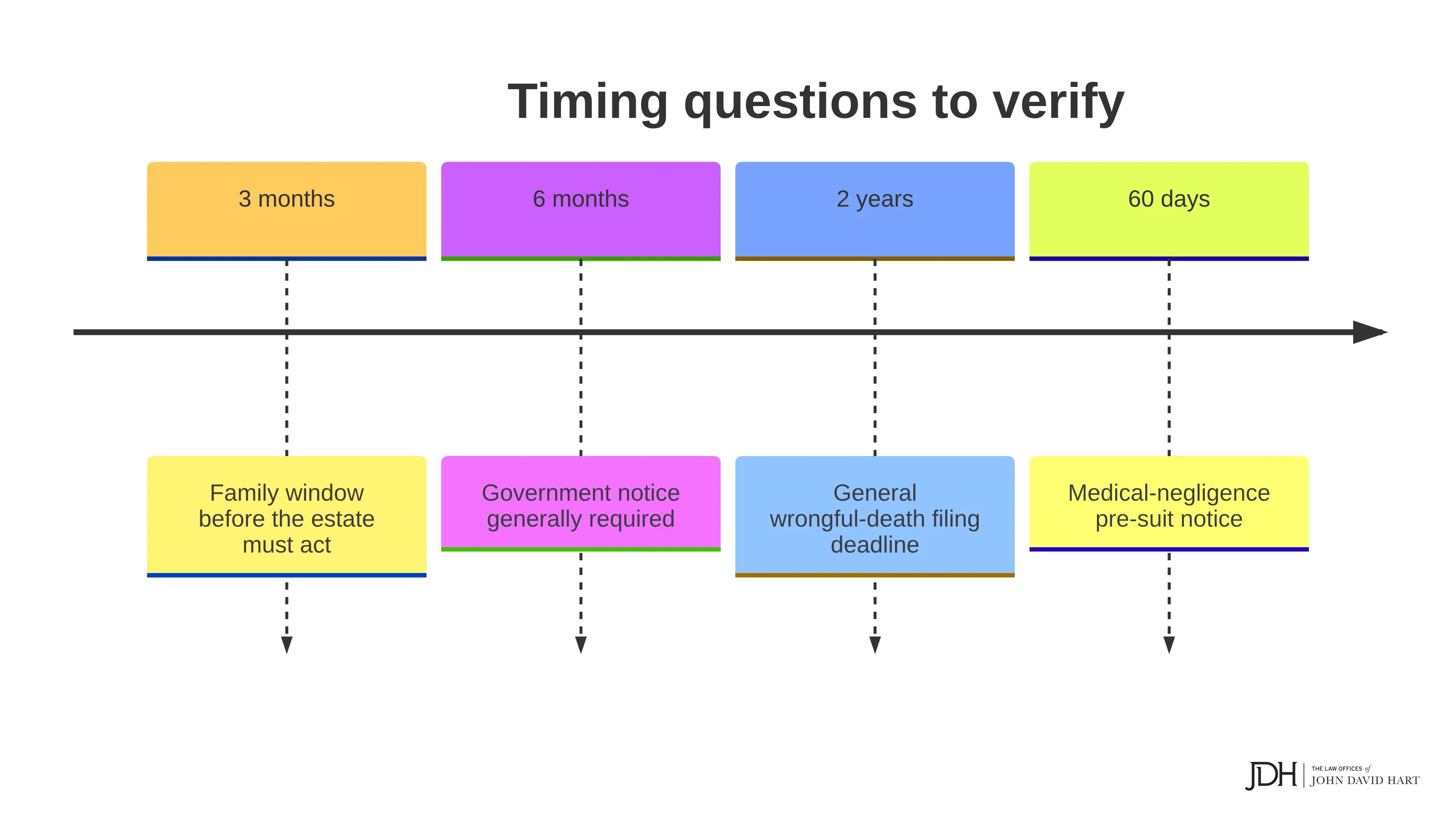
The listed Texas timelines address different situations. One listed rule gives a Texas family a window of 3 calendar months after the death before the estate must act. That timeline concerns the relationship between a family filing and estate action; it should not be treated as the general deadline for every wrongful-death lawsuit.
The general Texas lawsuit filing deadline listed for a wrongful-death claim is 2 years from the date of death. The existence of that general listing does not resolve exceptions, different defendants, special notice requirements, or the effect of facts in your matter. Give the lawyer the relevant dates rather than counting backward from a general rule.
Additional listed timelines may apply to particular situations. Notice to a Texas government entity is generally required within 6 months, and sometimes sooner under a city charter. For a Texas medical-negligence claim, pre-suit notice is listed as required at least 60 days before filing. An incident involving a public entity or medical care therefore deserves a prompt timing discussion.
A timing worksheet can include:
- Date of death.
- Date and location of the incident.
- Dates of medical treatment and communications with providers.
- Names of public entities, employers, insurers, or other organizations involved.
- Dates of notices, claims, records requests, or settlement communications.
- Any date a family member remembers as a possible deadline.
Write “to be assessed” beside dates you cannot interpret. Do not choose a filing strategy from the worksheet alone.
A prompt Texas legal assessment is the supported action when timing may matter. Bring the date information to the lawyer and ask which timeline applies, what facts could change the analysis, and what action must occur before any listed period expires.
Separate general guidance from a case-specific assessment
General guidance can help you organize a conversation, but it cannot determine whether your family has a viable claim. A checklist cannot decide eligibility, who may sue, fault, causation, damages, deadlines, likely results, or the legal effect of a particular document. Those questions depend on the facts of the matter and current Texas law.
A comparison guide also cannot establish that one lawyer is objectively better than another. Search position, a large practice description, a confident statement, or a nearby office does not supply the missing facts. Use those details only as prompts for questions about relevant experience, investigation, communication, staffing, and terms.
A case review can help you identify what the lawyer understands, what information is missing, and whether the working arrangement fits your family. It cannot guarantee that the lawyer will accept the matter or that the matter will produce a particular result. Ask the lawyer to distinguish a preliminary view from a conclusion supported by a completed investigation.
Use the guide for preparation, not substitution. Gather the available facts, ask the comparison questions, record the answers, and decide whether the lawyer’s explanation gives you a sensible basis for the next step.
Apply the checklist to available firm information without treating it as a ranking
At The Law Offices of John David Hart, we represent people in wrongful-death cases, as well as catastrophic personal-injury, truck and automobile accident, and workplace-injury cases. This practice information can help you decide which questions to ask about a family matter, but it does not establish that the available approach fits your facts or predict an outcome.
At The Law Offices of John David Hart, we also represent clients in oil and gas litigation, along with catastrophic personal injury, wrongful death, dangerous drugs and medical products, and automobile and truck accident cases. If your family’s matter involves oil-and-gas work or another specialized setting, ask how the relevant facts would be investigated and who would handle that work.
The available practice information is a starting point for a direct comparison. Ask:
- Which lawyer would evaluate your family’s matter?
- What experience is relevant to the incident you describe?
- How would the office investigate fault and causation?
- Who would communicate with the family and manage the records?
- What can be assessed during the initial conversation, and what requires more work?
- What representation terms would apply if the matter proceeds?
The answers matter more to your decision than a general category on a website.
A practice description cannot answer whether your family should retain The Law Offices of John David Hart. Compare the explanation you receive with the facts, questions, records, communication needs, and timing concerns you have identified. Choose only after you understand what the office can assess and what remains uncertain.
Request a case review when the available information fits the matter
A suitable next step is to gather the information you have, prepare the family and incident questions, and compare the lawyer’s experience and service approach with the needs of your matter. A qualified Texas lawyer must assess individual suitability, potential claims, timing, and the effect of current law on your specific facts. Use the initial conversation to learn what can be evaluated now and what requires further investigation.
At The Law Offices of John David Hart, we offer free, confidential consultations with no fee unless the case is won. Ask about the current representation terms, costs, and next steps before making a decision. If the available information and the conversation fit your family’s needs, provide the facts and records you have for the next-stage assessment.
Bring your chronology, family map, records list, unanswered questions, and timing information to the conversation. A clear comparison gives you a practical basis for deciding whether to move forward with this office or continue evaluating other Texas options.
Frequently asked questions about a Texas wrongful-death case review
What is a wrongful death claim under Texas law?
A wrongful death claim in Texas is a civil action brought when someone’s death is caused by another’s wrongful act, neglect, or default, allowing certain beneficiaries to recover damages for their losses.
What documents should I prepare for an initial case review with a wrongful death lawyer?
For an initial case review, you should gather documents such as police or accident reports, medical records, the death certificate, witness statements, and any relevant financial records.
What should I expect during a consultation with a wrongful death lawyer?
During a consultation, you should expect to discuss the details of the incident, the potential claims, and what information the lawyer needs to assess your case. It’s also a chance to ask questions about the lawyer’s experience and approach.
How does The Law Offices of John David Hart charge for wrongful death cases?
The Law Offices of John David Hart operates on a contingency fee basis, meaning there are no fees unless the case is won.
Hurt in a trucking & 18-wheeler accidents situation?
Talk directly with John David Hart — board-certified Texas trial lawyer. Free, confidential, no fee unless we win.
Get a Free Case Review Call 817-870-2102