
Last updated:
Decide what a Texas case review can and cannot establish
A Texas case review is an information-gathering step about a possible medical-negligence wrongful-death matter, not a decision that negligence occurred, that your family may file a claim, or that a lawyer will accept representation. In Texas, a wrongful death claim is a civil lawsuit based on a death caused by another party’s negligence or wrongful act, separate from any criminal prosecution.
That distinction matters after a death connected to medical care. You may have serious questions about what happened without yet having the records, medical analysis, or legal information needed to answer them. An initial discussion can help organize those questions and identify what requires further evaluation. It cannot promise eligibility, a particular fee, a recovery, or a result.
We represent clients in medical negligence and wrongful death cases. A request for an initial discussion therefore gives you a way to present the known facts, the records available to your family, and the points that remain unclear.
You do not need to decide the entire matter before seeking information. The practical decision is narrower: whether discussing the circumstances with counsel could help you understand the possible legal categories, organize the record, and identify questions that general information cannot answer. Keep that purpose in view throughout the process.
Understand the two possible claim categories before choosing a path
A Texas medical-malpractice death can involve a wrongful death claim for the family and a survival action for the estate. Those categories address different kinds of loss, so identifying both may help you ask a more focused question during a case review.
A wrongful-death claim concerns losses caused to eligible family members by the death. A survival action concerns claims belonging to the estate for losses the deceased person endured before death. The existence of two possible categories does not establish that either claim applies to your facts or that both would proceed.
It also states that if none of them files within three months, the estate’s representative must bring the claim unless all of them ask the representative not to.
Those rules make family structure and timing relevant at the beginning. Gather the names and relationships of the people affected, identify whether an estate representative has been appointed, and bring any information you have about earlier communications or filings. Do not assume that being related to the deceased person alone answers who may bring or benefit from a claim.
Possible damages in the family claim may include lost financial support, loss of companionship, mental anguish, and funeral costs. The explanation used here also identifies losses the family member endured before death as a possible part of the estate-related claim.
These categories describe subjects for investigation, not a value for your loss. Your records may help show what changed after the death, what expenses followed, and what the deceased person experienced beforehand. A case review can then separate documented facts from questions that require additional records or analysis.
Separate suspected medical negligence from a case assessment
Medical negligence is a legal question about healthcare-provider care that falls below what a reasonably careful provider would have done and causes real harm. A troubling outcome, an unexpected death, or a disagreement with treatment does not by itself resolve that question.
Start by writing down what you believe happened without converting the concern into a conclusion. Record the symptoms, treatment decisions you remember, communications with providers, and the point at which the patient’s condition changed. Preserve the distinction between what you personally observed, what someone told you, and what a medical record says.
A Texas medical-malpractice case requires proof of duty, breach, causation, and damages, backed by a mandatory expert report. Those requirements explain why a case review cannot be based only on the family’s understandable suspicion or on the outcome alone.
Use the review to ask which records may address each part of the analysis. Medical records may describe the care; timelines may clarify sequence; financial and family information may show consequences. The review does not replace the evidence-based evaluation needed to determine whether a case can proceed.
Know what no-win, no-fee generally covers—and what it may not
A Texas medical-malpractice lawyer can work on a contingency fee, with no attorney fee paid up front and the fee owed only from a recovery; case expenses are handled separately by the written agreement. The phrase no-win, no-fee therefore does not answer every financial question you may have.
Separate these two subjects during the discussion:
- Attorney fees: Ask whether the fee is calculated from a recovery and how the percentage changes between settlement, trial, and appeal.
- Case expenses: Ask which expenses may arise, who advances them, when they are repaid, and what happens to them if there is no recovery.
- The written agreement: Ask when you would receive it and whether the document explains each fee and expense term in plain language.
A clear distinction between fees and expenses can prevent you from treating the absence of an upfront attorney fee as an absence of all possible financial obligations.
A contingent-fee contract must be written and signed by the attorney and client, and it must state the percentages for settlement, trial, and appeal and how expenses are handled. The percentage is set in the written agreement and varies from firm to firm.
The fee explanation also states that a patient who loses owes a contingency-fee lawyer no fee, but case expenses depend on the agreement. That distinction is especially important in a wrongful-death matter because the exact parties, agreement, and expenses must be addressed for the case under consideration.
Ask for the terms in writing before signing. Do not rely on a short phrase to answer questions that belong in the agreement.
Prepare an accurate five-part record for the review
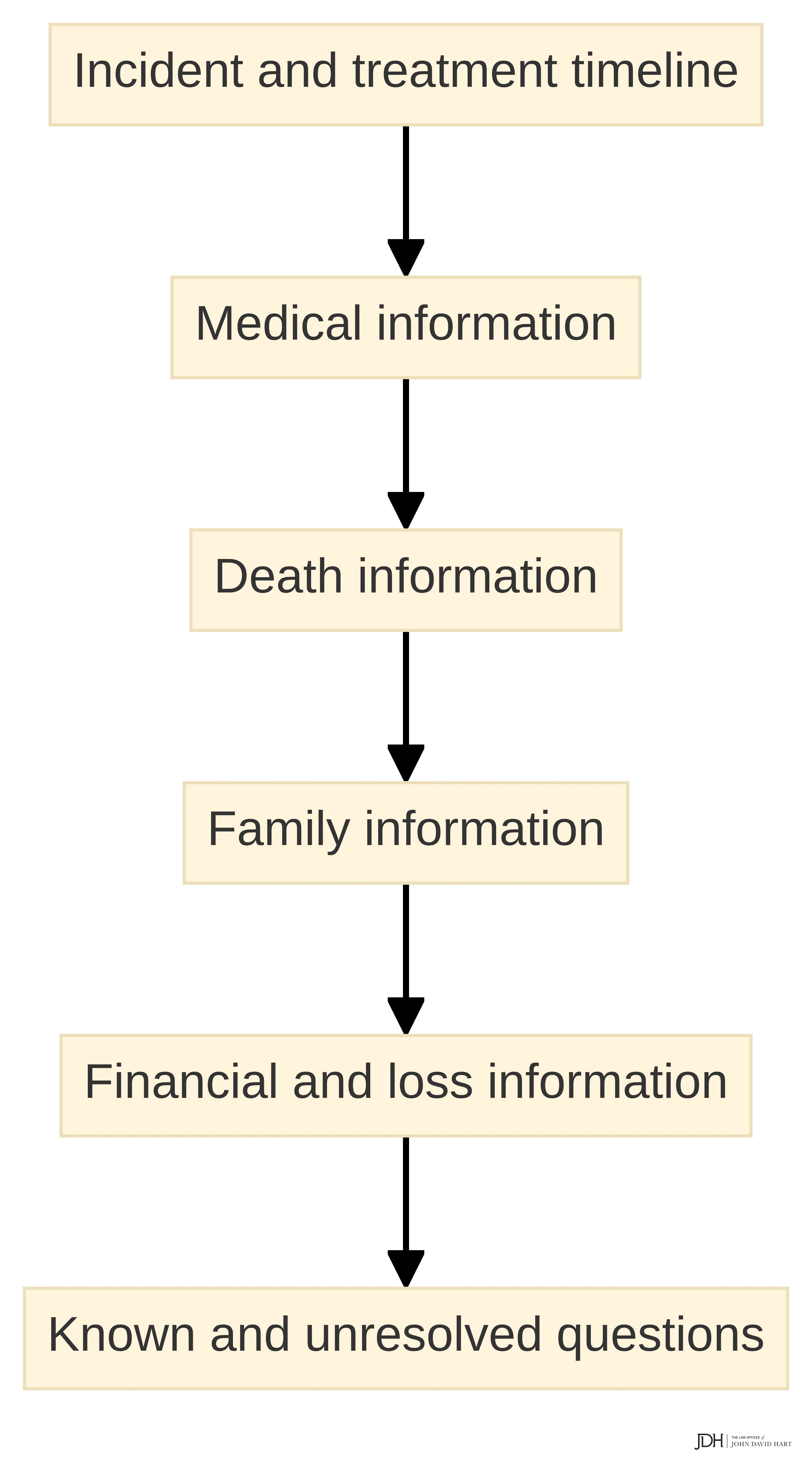
A five-part record can help you present the situation clearly without trying to prove the entire case before the first discussion. Use one folder, digital or paper, and label each item with its source and date when you know them.
Incident and treatment timeline. Write the dates and locations you remember, the healthcare providers involved, the symptoms or changes you observed, and the communications that followed. Mark uncertain details as uncertain instead of filling gaps from memory.
Medical information. Gather the records, discharge papers, test results, bills, prescriptions, correspondence, and other medical material already in your possession. Keep the originals unchanged and make working copies when you need to add notes.
Death information. Organize the death date, any document describing the stated cause of death, funeral or burial records, and information about whether an estate representative has been appointed. If a document is unavailable, list it as missing rather than guessing at its contents.
Family information. List the surviving spouse, children, parents, and other people who may need to communicate about the matter. Add relationship information, contact details, and any facts that explain who is managing records or estate affairs.
Financial and loss information. Collect wage or benefit information, proof of financial support, funeral costs, and records showing the effect of the death on the household. Texas guidance identifies lost financial support, loss of companionship, mental anguish, funeral costs, and losses endured before death as possible damage categories; your documents can help identify which subjects need discussion.
A usable record separates known facts from open questions. Create two short lists before the discussion:
- Known: what you personally saw, what a document says, and what date or source supports the detail.
- Unresolved: what you suspect, what conflicts between accounts, what records you have requested, and what you need explained.
Do not delete inconvenient messages, discard records, rewrite an earlier account to make it sound more certain, or select only the documents that support one explanation. Keeping the available record intact allows the discussion to begin with accuracy rather than with a polished but incomplete narrative.
You also do not need to estimate the value of the claim in advance. Bring the information that shows what happened and how the death affected the family; questions about legal categories, proof, and possible damages can be addressed separately.
To make the review more useful, turn the folder into a short handoff summary rather than relying on memory during the discussion. Put the family’s central question at the top in neutral terms, such as what records and facts are needed to evaluate the care and the death. Then organize the summary into five brief blocks:
- Sequence: list the treatment events and changes in condition in date order, with separate labels for documented, remembered, and unknown details.
- People and roles: identify the providers, surviving relatives, estate representative if known, and anyone who has possession of relevant records.
- Documents: list what is available, what has been requested, and what is missing. Note the source of each item without changing the original.
- Impact: identify the financial support, household changes, funeral costs, and other losses the family wants to discuss, without assigning a value.
- Questions: write the issues that need explanation, including whether the facts may involve a family claim, an estate-related claim, or both.
At the bottom, state what the review cannot decide from the summary alone: whether the care fell below the applicable standard and caused the death, whether a particular person may bring or benefit from a claim, and what deadline or written fee-and-expense terms apply. This creates a useful boundary between organizing information and reaching a legal conclusion. If two accounts conflict, preserve both versions and identify their sources instead of selecting the version that appears most favorable. If a document is unavailable, record that limitation plainly. A concise, source-labeled summary helps keep the conversation focused on verification and follow-up rather than on reconstructing basic facts in real time.
Use timing concerns to prompt verification, not a deadline conclusion
Texas timing concerns deserve early attention because the general explanation cited here states that the filing deadline runs from the date of the negligent act rather than the date of death. That may mean the deadline begins before a family realizes what happened.
The same explanation states that sending the required pre-suit notice with the required medical authorization before the deadline runs out adds 75 days to it. That statement does not calculate the deadline for your matter or establish that the extension applies to your facts.
Write down the dates of treatment, the suspected event, the death, record requests, and any notices or communications. Bring that timeline to a case review promptly. General information cannot determine the applicable deadline, tolling rule, notice requirement, or effect of the family’s specific circumstances.
A timing question is different from a deadline answer. Treat uncertainty as a reason to assemble the dates and seek case-specific evaluation, not as permission to assume that time remains or that a particular notice will preserve the matter.
Avoid changing records, delaying requests for information, or discarding messages while you try to reconstruct the timeline. A short chronology with clear labels such as “documented,” “remembered,” and “unknown” gives counsel a more useful starting point than a confident date that cannot be supported.
Ask the questions that clarify representation and written terms
A consultation question list can show whether the proposed arrangement is understandable before you make a decision. Texas fee guidance states that the contingent-fee agreement must be written and signed and must state the percentages for settlement, trial, and appeal and how expenses are handled.
Take these questions with you:
- What percentage would apply if the matter settles before trial?
- What percentage would apply if the matter goes to trial or appeal?
- Which case expenses may be advanced, and how would those expenses be repaid?
- If there is no recovery, would any case expenses remain payable under the proposed agreement?
- When would you receive the written agreement, and where does it explain each fee and expense?
- Who would sign the agreement and communicate for the family?
- Who may bring the potential wrongful-death claim, and how would the estate’s role affect the process?
- Are there any conflicts or other circumstances that prevent representation?
- How should you provide additional records or corrections after the initial discussion?
- How will the information shared during the discussion be handled before any representation decision?
Ask for the financial terms in writing before signing rather than treating a general no-win, no-fee description as the complete arrangement.
Texas Rule 7.01 requires communications about a lawyer’s services to be truthful and nondeceptive and prohibits material misrepresentations and unjustified expectations about results. You can use that standard as a reason to ask for clear answers instead of predictions.
Ask what the initial discussion can address, what information still needs to be obtained, and what decision would require additional review. Be cautious about any statement that treats acceptance, eligibility, a particular fee, or recovery as settled before the facts and written terms have been considered. A careful discussion should leave you with identified questions and next steps, not a promise that the matter will succeed.
Decide whether requesting a review is the right next step
We offer free, confidential consultations with no fee unless the case is won.
A qualified Texas lawyer must decide how the law applies to your family’s facts, who may bring a claim, whether the available information supports further evaluation, and what written fee and expense terms would apply. The consultation offer does not establish that your matter will be accepted or that your family will recover compensation.
Consider requesting a review when you have unresolved questions about the medical care, the death, the family’s legal position, the available records, or the financial arrangement. Bring the five-part record, mark uncertainty honestly, and use the question list to keep the discussion focused. The decision is whether that conversation could help you understand the next questions—not whether any result can be promised.
Questions families commonly ask before requesting a review
What does a no-win, no-fee arrangement mean in Texas?
In Texas, a no-win, no-fee arrangement means that you do not pay attorney fees upfront; instead, the lawyer’s fee is only owed if you win the case. However, case expenses may still apply and are handled separately.
What information should I prepare before requesting a case review?
Before requesting a case review, gather a five-part record that includes an incident timeline, medical information, death information, family details, and financial loss information. This will help present your situation clearly.
Who can file a wrongful death claim in Texas?
In Texas, a wrongful death claim can be filed by the surviving spouse, children, and parents of the deceased.
What questions should I ask during a consultation with a medical negligence lawyer?
During a consultation, ask about the percentage fee for settlement, trial, and appeal, which case expenses may arise, how expenses are handled if there is no recovery, and when you will receive the written agreement.
Hurt in a medical negligence situation?
Talk directly with John David Hart — board-certified Texas trial lawyer. Free, confidential, no fee unless we win.
Get a Free Case Review Call 817-870-2102