
Last updated:
Start with the decision a nearby lawyer should help you evaluate
Choosing a truck accident lawyer near you in Fort Worth starts with a fit decision, not a prediction about the outcome of your case. You need to determine whether a lawyer understands the type of crash you experienced, can work with the information available, explains the process clearly, and offers consultation terms you understand.
A useful consultation has three jobs:
- organize the facts without asking you to prove the entire claim yourself;
- identify the questions that require case-specific legal analysis; and
- help you decide whether the lawyer and the representation arrangement fit your situation.
The goal is not to turn a search result, crash report, or general article into a conclusion about fault, eligibility, damages, or recovery. The goal is to arrive prepared enough to have a focused conversation. That distinction matters after a serious crash, when medical appointments, insurance calls, vehicle damage, lost work, and family responsibilities can make it difficult to assemble a coherent account.
A nearby lawyer should help you evaluate four practical questions. First, does the lawyer handle truck-accident matters and serious injury cases that resemble yours? Second, can the lawyer explain which facts still need to be confirmed instead of treating an early account as complete? Third, will you know who communicates with you and what information the lawyer needs? Fourth, do the consultation and fee terms make sense before you decide whether to proceed?
Distance can matter for convenience, but physical proximity alone does not answer those questions. A Fort Worth office may be convenient, yet your choice should also reflect the location of the crash, the seriousness of the injuries, the type of vehicle involved, the available records, and the way the lawyer approaches communication. Use the sections below to prepare a concise packet, test fit with focused questions, and keep unresolved legal issues in their proper place.
Why a truck crash may require a focused evaluation
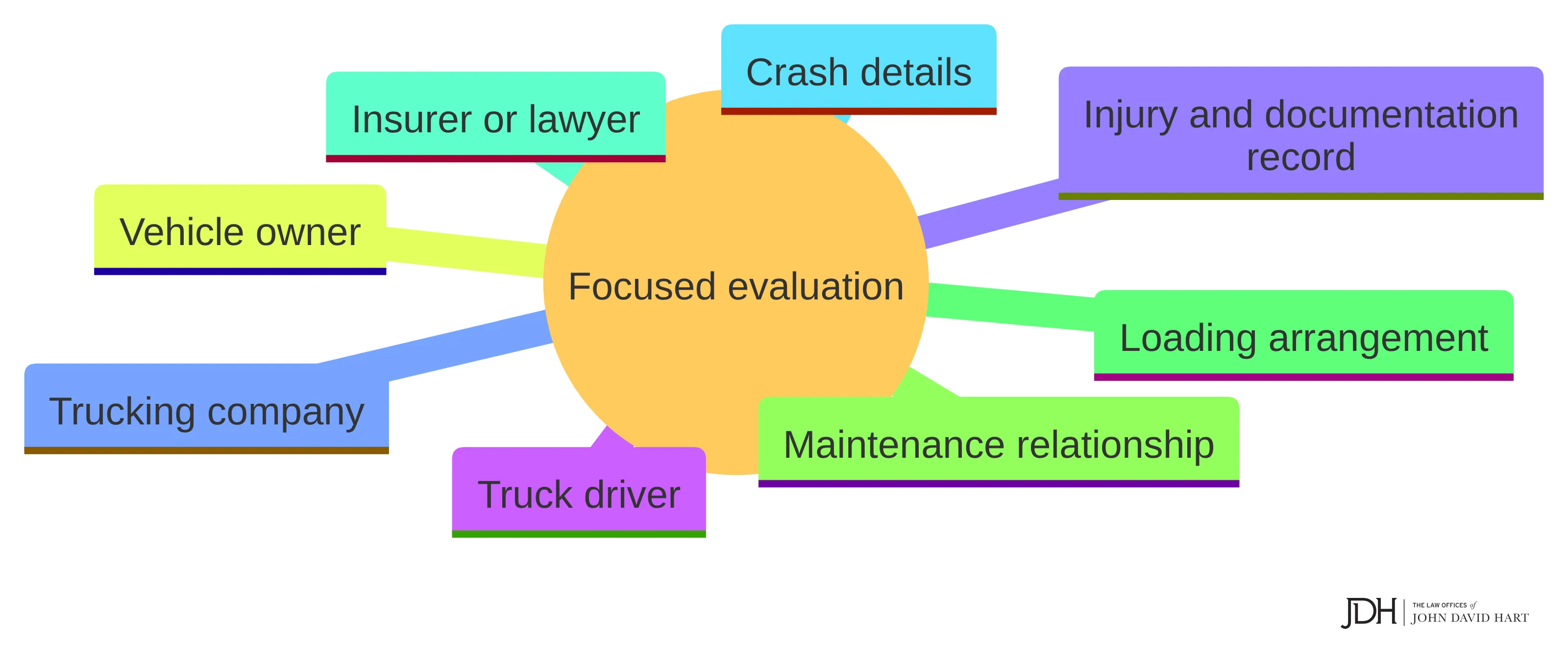
A commercial truck accident lawsuit can be more complex than an ordinary car-accident case because multiple parties may be involved, with separate lawyers and insurance coverage. A crash may raise questions about the truck driver, a trucking company, a vehicle owner, a maintenance relationship, a loading arrangement, or another participant, but you should not assume from the vehicle type alone that every possible party has responsibility. The available facts have to be sorted before those questions can be answered.
Separate representation and insurance coverage can also affect how information reaches you. An adjuster may be communicating for one party while another interested party has its own insurer or lawyer. That possibility is a reason to preserve the documents and messages you already have and to bring a complete account to a focused consultation. It is not a conclusion about who is legally responsible.
A focused evaluation should connect the crash details to the injury and documentation record. You may need to explain where the collision occurred in Fort Worth or elsewhere in Tarrant County, what vehicles were involved, how the impact unfolded, what treatment followed, and which insurers or representatives contacted you. The lawyer may also need to distinguish what you personally observed from what you learned later from a report, witness, passenger, medical provider, or insurer.
The type of truck can shape the questions without answering them. A tractor-trailer, delivery vehicle, work truck, or other commercial vehicle may require you to identify different facts about the vehicle and the people or businesses connected to it. The relevant issue is what the available facts show in your matter. Bring the facts you can identify. Do not fill gaps with guesses simply because a form or conversation seems to expect an answer.
Fort Worth and Tarrant County details belong in the first version of your account. Identify the road, intersection, highway entrance or exit, nearby business, direction of travel, and the agency that responded if you know them. Include whether the crash involved a chain of impacts, a later collision at the same location, or a separate event after traffic had stabilized. Those details can help you and the lawyer keep separate events from becoming one unclear narrative.
Your first packet does not need to settle the case. It needs to give the lawyer a reliable starting point and show which records or questions deserve attention next.
Set the boundaries before relying on general information
General information about Texas truck accidents can help you prepare questions, but it cannot turn a short description into a case-specific conclusion. A broad explanation may identify an issue to ask about; it does not establish that the issue applies to your crash, that a particular person or business is responsible, or that a particular result follows.
Keep four boundaries in view as you prepare:
- Do not treat a search result as a decision about fault or coverage.
- Do not treat a general deadline statement as the deadline for your matter.
- Do not estimate the value of an injury claim from another person’s story.
- Do not assume a lawyer’s location alone establishes the right fit for your case.
These boundaries make the consultation more useful because they preserve the difference between a question and an answer.
Your preparation should therefore focus on accuracy and questions rather than advocacy. Write down what you remember, label information that came from another source, and keep the original documents in their existing form. If a fact is uncertain, mark it as uncertain. A clear unknown is more useful than a confident detail that later proves inaccurate.
Use general information to identify topics for discussion, such as the parties involved, the insurance contacts you received, the records you may need, and the communication arrangement you want. Leave conclusions about legal eligibility, deadlines, damages, and recovery to the case-specific review. This approach lets you prepare without overreading a rule or a website description.
A short question list can keep the conversation on track. You might ask:
- Which facts about the truck, driver, company, or insurance arrangements still need confirmation?
- Which documents would help you understand the crash and injury record?
- Who will be your contact for ordinary questions, and how should urgent updates be sent?
- What consultation or fee terms should you understand before deciding whether to proceed?
You do not need to ask every possible question. Choose the questions that address the gaps in your own packet.
Build a concise Fort Worth crash-and-injury packet
A Fort Worth truck-crash packet should give a lawyer a usable timeline, contact map, injury summary, and document list without burying the central facts. Start with a one-page overview, then place supporting records behind it. If you do not have an item, list it as unavailable rather than delaying the consultation while you try to reconstruct everything.
Prepare two versions if that makes the process easier: a short summary for the first conversation and a fuller folder containing the records behind each point. The short version helps you explain what happened without losing the main sequence. The fuller folder gives you a place to preserve details that may matter later.
Use this checklist as a practical starting point:
- Location: the city, county, road, intersection, highway, direction of travel, and nearby landmarks.
- Timing: the date and approximate time of the crash, when you arrived for medical care, and when insurers or other representatives contacted you.
- People and vehicles: your name and contact information, passengers, witnesses, the truck or commercial vehicle description, license information if available, and the other vehicle details.
- Crash account: what you saw, heard, or felt; the sequence of impacts; traffic or weather conditions you remember; and whether a second impact occurred after the first event.
- Injuries and treatment: symptoms you noticed, emergency or follow-up care, providers, appointments, prescribed treatment, and changes to ordinary activities.
- Insurance: your insurer, the other driver’s or company’s insurer if known, claim numbers, adjuster names, letters, emails, texts, and recorded-statement requests.
- Documents and images: the crash report, photographs, video, vehicle-damage information, medical records or bills you have received, wage or work records, and relevant messages.
- Practical impact: missed work, transportation problems, household changes, and questions your family needs answered.
A timeline is often easier to use than a long narrative. List the crash first, then medical visits, insurer communications, vehicle events, and other significant developments in order. Put a question mark beside dates or details you need to confirm. Keep a separate list of people and organizations, including the police agency, emergency responders, medical providers, insurers, employers, witnesses, and any business connected to the truck.
Bring copies or digital versions that you can access during the consultation, but keep the originals. Do not edit photographs, messages, videos, or documents to make the sequence look cleaner. Preserve the material as it exists and explain the context.
An injury summary should describe what happened after the crash without trying to assign a legal value to each symptom. Note when symptoms began, which providers you saw, what treatment was recommended, and which daily activities changed. Include ongoing appointments and unanswered medical questions. If you are helping a family member, separate what you personally observed from what the injured person or a provider told you.
The packet can be short. Its immediate use is to help you present the location, crash, vehicle, insurance, injury, and documentation details in an orderly way.
Reconcile the crash record with what you remember
Texas crash-reporting instructions generally treat chain-reaction crashes occurring at one location and within a short time as one crash unless a stabilized situation separates the events. That reporting instruction gives you a useful reason to compare the report with your memory when several vehicles or impacts were involved. It does not, by itself, decide fault or determine how a legal claim should be analyzed.
A crash report may use descriptions, codes, diagrams, and terminology that do not match the words you used at the scene. Read it alongside your own account rather than replacing your memory with it. Mark differences in a separate note:
- the location, lane, direction, or point of impact;
- the number and order of vehicles or impacts;
- the names, addresses, or contact information listed;
- the reported injuries and whether later treatment appears;
- statements about witnesses, citations, weather, or road conditions; and
- any page, diagram, or attachment that appears incomplete or unclear.
Write down why you believe a detail differs. You may remember the event differently because you were injured, frightened, moved after the collision, or learned additional information later. The point of the comparison is to identify questions, not to force every account into identical wording.
Give the lawyer both the report and your marked questions. Avoid changing the original report or presenting your notes as if they were part of the official record. If another person has photographs, video, or a different account, identify that person and preserve the material in its original form.
A clear reconciliation note might say, "The report lists two impacts; I remember the first impact, then a later collision after traffic stopped." That sentence distinguishes observation from interpretation and gives the lawyer a concrete issue to explore.
The crash record is one part of the packet. It should be considered with medical records, photographs, vehicle information, witness accounts, insurer communications, and your own timeline. A discrepancy is a reason to ask a focused question, not a reason to assume that your memory or the report automatically controls.
Use the consultation to test truck-accident fit
A lawyer-fit consultation should test experience, communication, preparation, and matter fit together. Texas Bar consumer guidance advises clients to be prompt, keep the lawyer updated about changes to contact or employment information, and be completely honest about the legal matter. The consultation can clarify what the lawyer needs from you and how the lawyer’s team will communicate with you.
For example:
- What types of truck-accident matters do you handle?
- How would you organize the driver, trucking company, vehicle, insurer, and other possible-party information in an early review?
- What documents should I prioritize if my packet is incomplete?
- Who will communicate with me about ordinary updates and questions?
- How should I send new medical information, insurer messages, photographs, or witness details?
- What issues would you need to investigate before discussing the next stage?
Listen for answers that distinguish known facts, open questions, and matters requiring further review. The discussion can focus on what remains to be confirmed rather than on predicting an outcome.
Fort Worth fit also includes practical access. Ask whether meetings can be handled in a way that works with your treatment, transportation, work schedule, or family responsibilities. Explain where the crash occurred and whether the matter involves another Texas location. The purpose is not to treat convenience as the only criterion; it is to find out whether the communication arrangement is workable for you.
If you are contacting more than one lawyer, use the same core questions and record the answers in separate notes. Consistent questions make it easier to compare communication and case-fit information without turning the process into a ranking based on advertising language.
After each consultation, write down what the lawyer said the next information need would be, which questions remained open, and what consultation or fee terms were discussed. Keep those notes separate from your original crash account. The separation helps you remember the conversation accurately without changing the underlying record.
You can also record whether the lawyer explained the next step in plain language, identified information still needed, and told you how to send updates. Those observations give you concrete material for your decision instead of relying on how persuasive the conversation felt.
Compare consultation terms before making a choice
| Question to compare | Flat-fee arrangement | Contingent-fee arrangement |
|---|---|---|
| How is the arrangement described? | Ask what defined work or stage the stated amount covers. | Ask what outcome or matter the arrangement covers and how the percentage is described. |
| What should you clarify? | Ask about work outside the defined scope and any separate expenses. | Ask which expenses, costs, or services are addressed and when they are charged. |
| What does the arrangement tell you? | It describes a fee structure, not whether the case is legally valid or what result will occur. | It gives you terms to compare: the percentage, expenses, and work covered. |
| What should you keep? | Keep the written terms and notes about the work covered. | Keep the written terms and notes about the percentage, expenses, and work covered. |
We charge no fee unless the case is won. That statement is a consultation term for The Law Offices of John David Hart, not a promise about whether a particular truck matter will be accepted or what result it will produce. Ask which written terms apply to your matter and keep a copy of what you receive.
Do not choose a lawyer based on a fee phrase alone. Compare the fee discussion with the lawyer’s truck-accident experience, explanation of open questions, communication plan, and ability to work with the facts you can provide. A lower apparent cost does not answer whether the arrangement covers the work you need, and a more detailed discussion does not answer whether the lawyer is the right fit. Make the comparison using the same questions for each consultation.
Ask for clear communication and protect accuracy
Clear communication is part of a workable attorney-client relationship. Texas Bar consumer guidance advises clients to be prompt, tell the lawyer about changes to contact or employment information, and be completely honest about the matter. Before deciding, ask how you should report a new address, phone number, employer, medical development, insurer message, or change in treatment.
A practical communication plan can include:
- the name or role of your ordinary contact;
- the preferred phone number, email address, or portal for routine information;
- the method for sending photographs, reports, bills, and messages;
- what information should be sent immediately rather than held for the next appointment; and
- how you will receive updates about requests for records or additional details.
Write down the plan after the consultation. If your contact information or employment changes, update the lawyer promptly. Keep copies of messages you send and receive so the timeline stays complete.
Honesty includes uncomfortable facts, incomplete memories, prior communications, and information that may not seem helpful to your account. The Texas Bar says information told to a lawyer in private is confidential, subject to the stated exception for plans for future crimes and continuing criminal activity. Ask the lawyer how confidentiality applies to your communication if you have a specific concern, and do not omit a material fact because you are worried about how it will sound.
Accuracy does not require you to memorize a perfect story. Use your timeline, identify uncertainty, and correct a mistake when you notice it. Do not guess at speed, coordinate accounts with witnesses, or alter a photograph, message, or report. A careful correction is more useful than an answer that sounds certain but cannot be supported by your records.
Apply the screen to The Law Offices of John David Hart
We represent clients in automobile and truck accidents, catastrophic personal injury, wrongful death, medical negligence, and workplace injury cases. That stated practice scope is directly relevant to a Fort Worth truck-accident search, but it does not by itself determine whether we can represent your particular matter. The facts, injuries, parties, location, and available information still need to be reviewed.
John David Hart is board certified in both Personal Injury Trial Law and Civil Trial Law by the Texas Board of Legal Certification. John David Hart founded The Law Offices of John David Hart in Fort Worth. You can use those facts as part of your qualification screen, then ask the same practical questions you would ask any lawyer: how the truck matter would be evaluated, which information is needed, and how communication would work.
We offer free, confidential consultations for catastrophic injury cases. If your truck crash caused a catastrophic injury, bring the packet described above so the conversation can focus on the crash, treatment, parties, insurance contacts, and documentation. A free consultation removes the consultation charge described in this firm information; it does not answer the legal questions in advance.
Use this firm-specific screen during the conversation:
- Can you explain how the available truck, driver, company, vehicle, and insurance information would be organized?
- Can you identify which facts are known and which require confirmation?
- Can you explain who will communicate with you and how to send updates?
- Can you explain the consultation and fee terms in writing?
- Can you tell you what information would be useful next without asking you to guess?
The same screen keeps your decision grounded in fit rather than in a single credential, slogan, or search position.
Know what the available firm information does not establish
A stated practice area, board certification, Fort Worth location, consultation offer, or fee arrangement does not establish that your claim is valid, identify every responsible party, set a filing deadline, calculate damages, or predict recovery. Those are separate questions tied to the facts and governing law of your matter. Treat each firm detail as information for your fit decision, not as a conclusion about the result.
Your consultation may still leave practical questions open. The lawyer may need more information about the crash sequence, the truck and company relationships, the insurance contacts, the medical course, your work impact, or the location and timing of events. An incomplete packet is not a reason to invent details. Give the lawyer what you have, identify what is missing, and ask what should be gathered next.
Use the following decision boundary after the conversation:
- If the lawyer’s stated scope does not fit the matter, continue looking for a more appropriate fit.
- If communication expectations are unclear, ask for clarification before moving forward.
- If the fee arrangement is unclear, request written terms before relying on it.
- If important facts remain uncertain, preserve the records and ask which issue needs attention first.
- If the process fits your needs and you understand the open questions, decide whether to take the next step under the terms provided.
This screen helps you make a deliberate choice without treating general information as a personal legal conclusion.
Request the free case review
A prepared truck-accident consultation gives you a clearer way to compare fit. Bring the Fort Worth location and timeline, injury and treatment information, truck and vehicle details, insurance contacts, crash records, photographs, messages, and a short list of unanswered questions. We represent clients in truck-accident and catastrophic personal injury matters, offer free, confidential consultations for catastrophic injury cases, and charge no fee unless the case is won.
A qualified Texas lawyer must assess your individual situation, including whether representation is appropriate and which legal issues require case-specific review. Use the consultation to present accurate information, understand the open questions, and decide whether the communication and fee terms fit your needs.
Keep your packet accessible and submit the details you can provide without waiting for a perfect record. Your location, injury information, crash account, vehicle details, insurance communications, and available documents give the conversation a practical starting point.
Hurt in a trucking & 18-wheeler accidents situation?
Talk directly with John David Hart — board-certified Texas trial lawyer. Free, confidential, no fee unless we win.
Get a Free Case Review Call 817-870-2102